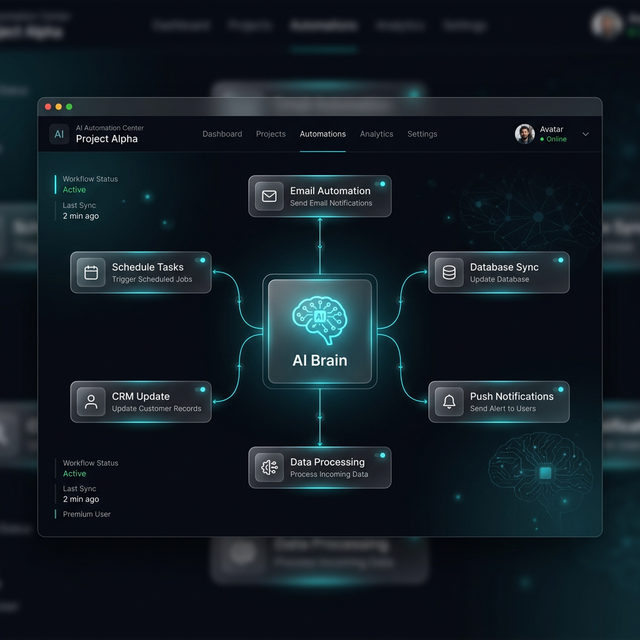
Adding AI to your automation workflows is no longer a complex engineering task. With Make.com's HTTP module and OpenAI's API, you can build systems that intelligently process text, classify data, extract structured information, and make decisions — all as part of your existing automation flows.
What AI Adds to Your Automations
Traditional automation handles structured data: "if field X equals value Y, do Z." AI unlocks the ability to handle unstructured data — emails, user messages, documents, and form responses — and turn them into structured outputs your automation can act on.
- Classification: "Read this support email and return its category: billing, technical, or general."
- Extraction: "Extract the company name, budget, and timeline from this inquiry message."
- Summarization: "Summarize this 3,000-word meeting transcript into 5 bullet points."
- Generation: "Write a personalised follow-up email for this lead based on their enquiry."
Setting Up the OpenAI Module in Make.com
Make.com has a native OpenAI integration. Here's how to use it:
- Add an OpenAI → Create a Completion module to your scenario.
- Connect your OpenAI API key (from platform.openai.com).
- Set the model to
gpt-4o-minifor cost efficiency, orgpt-4ofor accuracy. - Write a system prompt that instructs the AI exactly what to return and in what format.
Real Example: AI Lead Qualification
Here's a workflow I built for a consulting client:
- Website form submission triggers the Make.com webhook.
- The message field is sent to OpenAI with the classification prompt above.
- Make.com parses the JSON response using the JSON Parse module.
- If
intent === 'hot', the lead is immediately added to HubSpot as "High Priority" and the sales rep gets a Slack notification. - If
intent === 'warm', they enter a nurture email sequence. - If
intent === 'cold', they're added to HubSpot but no action triggers.
"This single workflow saved one client 4 hours per day of manual lead review — and improved their response time to hot leads from 3 hours to under 60 seconds."
Cost Considerations
GPT-4o-mini costs roughly $0.00015 per 1K input tokens. For a typical 300-word enquiry, that's less than $0.0001 per classification. Even at 1,000 leads per month, the AI cost is under $0.10. The ROI is immediate.
Getting Started
The key to reliable AI in automation is good prompt engineering. Be specific, require structured output (JSON), and always validate the output format before passing it to subsequent modules. Need a system like this built for your business? Let's talk.